Tech
Mac Mini M4
The Mac mini is small in size and small in revenue (CFOTO/Getty Images)
Apple’s pie

How much Apple’s biggest contribution to the AI boom matters for its sales

Hint: it’s not Siri and it’s not much.

Three and a half years after ChatGPT burst onto the scene with widely available generative AI, Apple has yet to release an AI assistant that can reliably discuss the weather or do anything to justify calling it “intelligence.” Instead Apple appears to be positioning the iPhone as a distribution layer for competitors’ superior models. To borrow from Wedbush Securities analyst Dan Ives’ previous comments, Apple’s AI strategy remains mostly “invisible.”

That said, the company has been making a roundabout contribution to AI through some of its lesser-known hardware: the Mac mini. The small, screenless desktop computer has become a relatively affordable, low-friction way for developers and hobbyists to run AI models locally, without relying on Big Tech’s cloud infrastructure. So popular is the device that on the company’s earnings call last week, CEO Tim Cook said it was facing shortages that would last “several months.”

“On the Mac mini and the Mac Studio, both of these are amazing platforms for AI and agentic tools, and the customer recognition of that is happening faster than what we had predicted,” Cook said. “And so we saw higher-than-expected demand.”

Apple shipped 298,000 Mac minis in the first quarter, up 8% from a year earlier, according to new data from IDC.

How is that demand contributing to Apple’s top line? Not very much.

Counterpoint Research Associate Director David Naranjo told Sherwood News that even amid increased demand, the Mac mini accounts for about 3% of Mac unit sales and less than 1% of total Apple revenues. A back-of-the-envelope calculation using IDC shipment data suggests Mac mini revenue was ~0.5% of Apple’s total last quarter, assuming many buyers opted for more expensive, high-memory M4 Pro configurations that run about $2,200.

Of course, even 0.5% of Apple’s revenue — $416 billion last year — is still a tidy sum, even if it’s a rounding error for Apple.

“It was always an odd product dating back decades, to when Apple wanted to persuade customers to switch to a Mac without needing to buy a new monitor, keyboard, and mouse,” Michael Levin, cofounder and partner at Consumer Intelligence Research Partners, told Sherwood. “Not sure why they kept it around, but now they found consumer interest, as a CPU for AI applications.”

The rise of AI agents has spurred a reevaluation of how big of a role CPUs will play in the boom by “orchestrating” workflows for their bigger-brained GPU counterparts to carry out.

That newfound interest is quickly shifting the Mac mini’s identity from a budget entry point to a premium developer tool. Consequently, Apple recently discontinued its $599 entry-level configuration, effectively raising the starting price to $799 to prioritize higher-margin models.

More Tech

See all Tech
tech

OpenAI employees are cashing out their shares, dozens making $30 million each

OpenAI’s planned IPO later this year is expected to be one of the largest of all time. Employees who got equity early on are sure to reap a windfall when the company shares hit the public markets.

Often these pre-IPO shares can’t be cashed in until the company goes public, and many startups have longer lockup periods before employees can sell their shares.

But The Wall Street Journal reports that OpenAI has a relatively short two-year vesting period, and the company allowed employees to sell shares before the IPO via a tender offer, as long as they’ve reached the two-year mark.

According to the report, in October, more than 600 current and former OpenAI employees sold shares through this process, minting a cluster of new multimillionaires. The Journal said about 75 of those walked away with $30 million (the maximum sale amount for this offer).

But The Wall Street Journal reports that OpenAI has a relatively short two-year vesting period, and the company allowed employees to sell shares before the IPO via a tender offer, as long as they’ve reached the two-year mark.

According to the report, in October, more than 600 current and former OpenAI employees sold shares through this process, minting a cluster of new multimillionaires. The Journal said about 75 of those walked away with $30 million (the maximum sale amount for this offer).

tech

Intel pops on reported Apple chip deal

Intel soared more than 14% on a Wall Street Journal report saying the company has reached a preliminary agreement with Apple to manufacture chips for the iPhone maker. Intel, already on a tear as of late, jumped earlier this week when Bloomberg first reported the two companies were in talks. It’s still unclear which chips Intel would manufacture for Apple, which has been facing supply constraints for its iPhone as well other products.

In any case, the deal could help Apple ease supply constraints that have hit some of its products and reduce its reliance on longtime partner TSMC, as it aims to bring more chip manufacturing stateside.

In any case, the deal could help Apple ease supply constraints that have hit some of its products and reduce its reliance on longtime partner TSMC, as it aims to bring more chip manufacturing stateside.

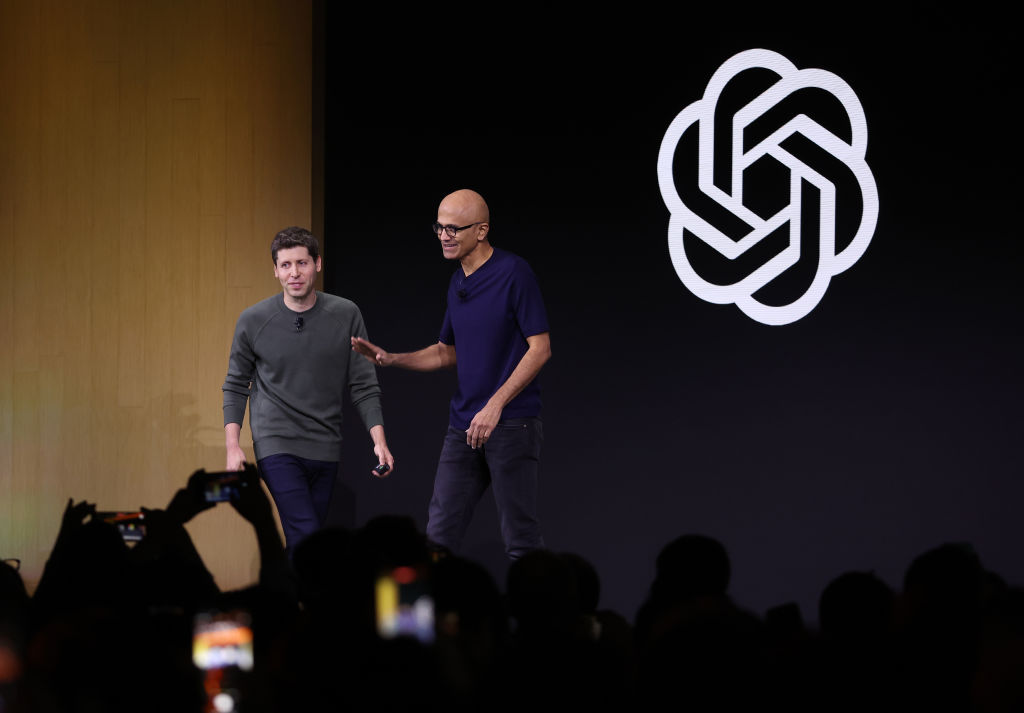
Microsoft CEO Satya Nadella (R) greets OpenAI CEO Sam Altman during the OpenAI DevDay event

Emails show Microsoft wasn’t impressed by OpenAI’s early work, but wanted to keep it from Amazon

OpenAI wanted further Azure computing discounts, but Microsoft didn’t think it was on the verge of a breakthrough.

tech

Wedbush’s Dan Ives raises Apple price target to $400 on $15 billion AI services opportunity

Apple may not have a frontier AI model or a fully functional AI assistant, but that won’t stop the company from throwing its weight around in the “AI revolution,” according to Wedbush Securities analyst Dan Ives. That’s enough for Ives to raise his price target for Apple shares to $400 from $350.

Underpinning that jump is what Ives sees as a $15 billion annual revenue opportunity for Apple in AI services from monetizing other companies’ models by distributing them to its 2.5 billion iOS users. Ives estimates that in the coming years, roughly 20% of the world’s population will access AI through an Apple device, calling it the “consumer hub of AI.”

That new era, Ives expects, will officially kick off at Apple’s developer conference in June, where he expects Apple to “finally unveil its AI strategy.”

Latest Stories

Sherwood Media, LLC produces fresh and unique perspectives on topical financial news and is a fully owned subsidiary of Robinhood Markets, Inc., and any views expressed here do not necessarily reflect the views of any other Robinhood affiliate, including Robinhood Markets, Inc., Robinhood Financial LLC, Robinhood Securities, LLC, Robinhood Crypto, LLC, Robinhood Derivatives, LLC, or Robinhood Money, LLC. Futures and event contracts are offered through Robinhood Derivatives, LLC.